Sign up for PayPal and start accepting credit card payments instantly.
Custom Search

Minggu, 22 Desember 2013

How to Restore and Maintain Your Vespa


Your number one Vespa restoration resource! With plants in 15 different countries and sales numbering well into the millions worldwide, Vespa is the make among scooter marques. Return your Vespa to its original glory with this complete guide to restoring your prized scooter to 100% original. This information-packed, authentic restoration guide covers both the mechanical and cosmetic restoration of all Vespa motorscooters from 1946-1996.


Product Details

  • Series: Motorbooks Workshop
  • Paperback: 160 pages
  • Publisher: Motorbooks; 1st edition (December 27, 1999)
  • Language: English
  • ISBN-10: 0760306230
  • ISBN-13: 978-0760306239
  • Product Dimensions: 0.4 x 8.5 x 10.8 inches

Piaggio Vespa Gts 300 I.E. Super 2008/12 With Catalyst Full Exhaust System Vintalogy By Gpr


Piaggio Vespa Gts 300 I.E. Super 2008/12 With Catalyst Full Exhaust System Vintalogy By Gpr


Product Description

Vintalogy Line By Gpr Exhaust System! The Best Scooter Product On Market! Incredible Resistance Due To The Fact That Is 100% Stainless Steel Made With Handpolishing, Great Sound And Performance, Up To 2,5 Hp Of Increase, Visit Gpr Youtube Channel Or Website! Included In The Price Are Manifold Stainless Steel Made As Well, Bracket Kit, Removable Db Eater And Lambda Boss. Plug And Play Kit, You Don'T Need To Cut Anything. 2 Years Warranty.

Product Information

Technical Details
BrandGPR Exhaust System
Item model numberVIN.CAT.2
Manufacturer Part NumberVIN.CAT.2
  
Additional Information
ASINB00C9ZYO38
Customer ReviewsBe the first to review this product
Shipping InformationView shipping rates and policies
Date First AvailableApril 8, 2013
  
Warranty & Support
Warranty, Parts: Parts
Feedback

Rabu, 13 Juli 2011

Vespa: The Complete History From 1946


Special Offers and Product Promotions
* Pre-order Price Guarantee! Order now and if the Amazon.com price decreases between your order time and the end of the day of the release date, you'll receive the lowest price. Here's how (restrictions apply)

Editorial Reviews

Product Description
April 1946 was the debut date of the revolutionary little two-wheel vehicle, which, as well as leaving an indelible mark on the history of transport, became a real cultural phenomenon to successive generations. Simple and elegant, practical and comfortable, these are some of the characteristics that have ensured the popular scooter an unrepeatable success, with 35,000 of them built in 1949 alone. Sixty-five years after its birth, the Vespa, of which over 17 million have been produced, has affirmed itself throughout the world. This book covers the fascinating epic of the Vespa, from its debut to the present day, through hundreds of pictures and invaluable documents of its various epochs.
Book Description

April 1946 was the debut date of the revolutionary little two-wheel vehicle, which, as well as leaving an indelible mark on the history of transport, became a real cultural phenomenon to successive generations. Simple and elegant, practical and comfortable, these are some of the characteristics that have ensured the popular scooter an unrepeatable success, with 35,000 of them built in 1949 alone. Sixty-five years after its birth, the Vespa, of which over 17 million have been produced, has affirmed itself throughout the world. This book covers the fascinating epic of the Vespa, from its debut to the present day, through hundreds of pictures and invaluable documents of its various epochs.
About the Author

Giorgio Sarti was born and lives in Milan. He is a qualified engineer and since 1982 he has been contributing to a series of important motorcycling periodicals as a journalist. He is a great motorcycling enthusiast and is the author of the first historical encyclopedia of motorcycles on Italian, Japanese, European and American motorcycles of the ’60s, ’70s and ’80s

Jumat, 08 Juli 2011

Vespa Commercial


VESPA IS THE LEGEND..

Senin, 25 April 2011

Vespa 125 - 1948

Vespa 125 - 1948

Year(s) of production
1948 / 50
VIN
V1T - V15T
Number
01 / 104096
Production
104096


This 125 is based on the 98cc from the past years. They offer more power than other models. The rear shock absorber made is apparition this year, and the front one was modified. The front wheel was placed on the left side of the column, for a better stability when riding.
Also the 125 models were equipped with the rear-rack and the fuel-tap with a reserve position.
For the rear suspension, Piaggio put for the first time the complete motor and transmission assembly directly on the wheel and supported it by a single shock absorber.

The front fender is now build in one piece.

Senin, 11 April 2011

Vespa Rayakan Ultah Ke-65 di Roma

ROMA, KOMPAS.com — Produsen sepeda motor Italia, Vespa, akan merayakan ulang tahun ke-65 pada 23 April mendatang. Ikon skuter negeri piza ini didirikan pada 23 April 1946 di Florence saat Piaggio dipatenkan sebagai Vespa 98 cc. Vespa ini menjadi skuter pertama sebagai transportasi pasca-Perang Dunia II.

Selama 65 tahun, Vespa telah terjual 17 juta unit dan penjualan tahun lalu tercatat 133.000 unit. Jumlah itu bertahan selama lima tahun berturut-turut dengan menampilkan enam model dan dua kali lipat lebih banyak dibanding 2003 dengan catatan penjualan 50.000 unit.

Menandai perayaan ulang tahunnya (ultahnya), Vespa akan melakukan parade yang sudah dimulai pada 3 April lalu melalui berbagai kota menggunakan Vespa PX 2011. Acara puncaknya akan berlangsung di Roma dengan berbagai kegiatan.

PX dipilih karena merupakan model paling sukses dalam sejarah perusahaan dengan penjualan tertinggi 3 juta unit di seluruh dunia. Skuter tersebut dilengkapi empat gigi persneling dengan mesin 2-tak berkapasitas 123 cc dan 150 cc.

Nah, scootermania Indonesia bisa gabung di Roma.

Senin, 04 April 2011

The Begin of Legend 1946, Vespa 98

Vespa 98 - 1946
Year(s) of production 1946 / 47
VIN V98
Number 01 / 18079
Production 18079


This is the first Vespa that gives us the myth. This succes is due to it's low price, and it's small consommation of fuel: 3 litres/100 km, for a top speed of 75 km/h and cruising of 50 km/h. On this first model, it was equiped with an external drive shaft between the rear wheel and the motor.
Front fork use a drag type wheel with the axle and shock absorber slightly aft of the fork. It's the same thing used on landing gears of many aircraft.


Selasa, 29 Maret 2011

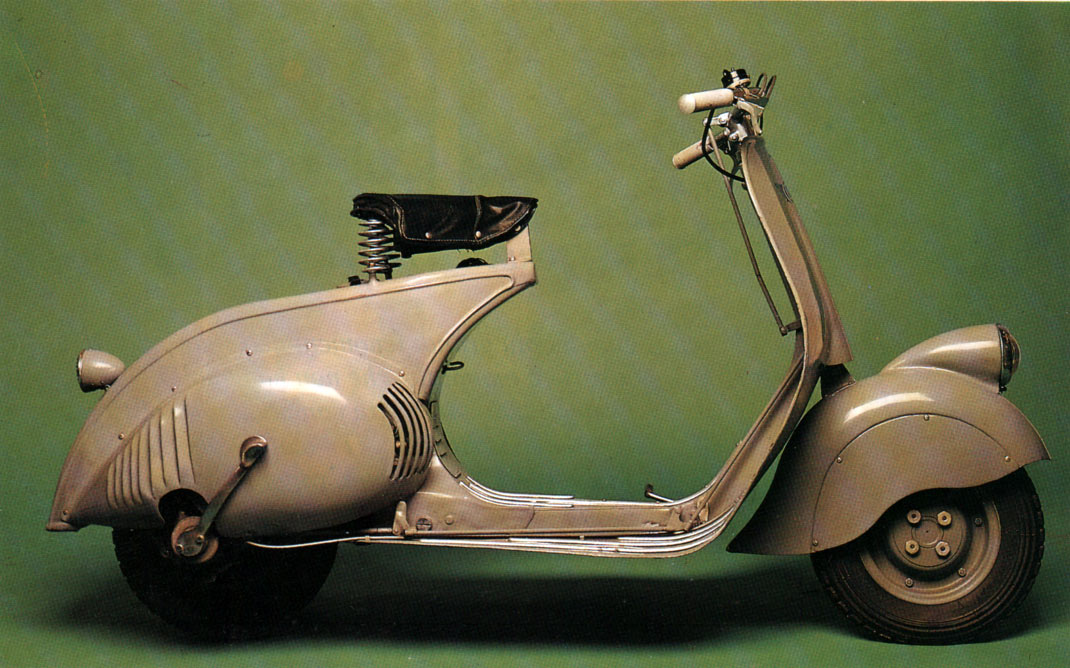
Early Vespa "The Prototype" 1945

The Prototype of Vespa. Called "Paperino". This is the first generation of Legendary Vespa.

Paperino Prototype


MP6 Prototype
Vespa jenis Paperino memang sangat berbeda dengan desain Vespa yang ada saat ini tapi untuk tife MP6 mulai mendekati Vespa yang sering kita lihat


Sabtu, 19 Februari 2011

Konsumen Usah Ragu, ATPM Piaggio dan Vespa Serius di Indonesia


Jakarta - Sandy (sebut saja begitu), binggung ketika membaca di surat kabar perihal rencana Piaggio & C. Spa., yang ingin menjadi ATPM motor Piaggio dan Vespa di Indonesia. Pasalnya selama ini dia beli Vespa LX-nya dari dealer Piaggio/Vespa kepunyaan PT Sentra Kreasi Niaga (SKN). “Nanti kayak saat PT Danmotor (ATPM Piaggio dahulu, red) tutup. Pemilik Vespa enggak tahu harus kemana,” ujarnya.

SERIUS

Kekhawtiran Sandi ataupun orang-orang lain pemilik Vespa dan Piaggio sebenarnya enggak perlu berlebihan. Karena sejatinya dia bisa bernafas lega karena manufaktur Piaggio mau investasi ke Tanah Air untuk buat ATPM. Artinya, mereka serius untuk membesarkan brand motor asal Italia itu. Seperti itukah?

Menurut Sergio Mosca, vice president Indonesia business development Piaggio yang ditunjuk sebagai perwakilan Piaggio & C. Spa Italia di Tanah air mengatakan pasar motor di Indonesia sangat penting. “Dalam hal unit yang terjual kita melihat pasar lebih besar di Cina dan India. Tapi jika kita mempertimbangkan volume penjualan x harga rata-rata, Indonesia merupakan industri motor terbesar di dunia,” jelasnya.

Melalui emailnya ke OTOMOTIF, Mosca kembali tegaskan Piaggio serius garap pasar Indonesia. “Rencana sekarang mendirikan sebuah perusahaan (PT Piaggio Indonesia) untuk mendistribusikan produk kami,” imbuhnya Mosca seraya menjelaskan akan resmi mulai beroperasi pada bulan Juni, bertepatan dengan Pekan Raya Jakarta 2011 di Kemayoran, Jakpus.

Untuk regional Asia Tenggara, Piaggio akan memasarkan 3 model (Vespa LX, Piaggio Liberty dan ZIP) yang telah diproduksi di pabriknya di Vietnam. Kenapa Piaggio tidak mendirikan pabrik atau assembling plant di Indonesia?

Mosca menerangkan pada tahun 2008 saat Piaggio mempelajari untuk membangun pabrik di kawasan Asia Tenggara, Piaggio butuh 3 syarat. Pertama, perekonomian negara itu harus berkembang, pasar motornya berkembang dan pasar motor Piaggio juga harus berkembang.

“Di Indonesia (tahun 2008) punya 2 syarat pertama (perekonomian dan pasar motor berkembang). Tapi syarat ketiga tidak ada. Sedangkan di Vietnam punya ketiga syarat itu,” bebernya.

Meski tak ingin bangun pabrik, Piaggio seakan komit untuk membangun brand Piaggio di Tanah Air. Terbukti dari persiapan bangun dealer, aftersales service dan spare part. PT Piaggio Indonesia (rencana nama perusahaannya) bakal bangun setidaknya 70 dealer sepanjang 2011 ini di kota-kota besar.

"Ketersediaan purna jual dan spare part adalah faktor kunci sukses. Makanya kami berencana mendirikan beberapa bengkel dan gudang spare part di Indonesia untuk mendukung bisnis,” sahut pria yang pernah bekerja di ATPM mobil Fiat di Tanah Air ini.

Mudah-mudahan serius. (motorplus.otomotifnet.com)
Penulis : Pj | Editor : AZ | Foto : Istimewa

Senin, 14 Desember 2009

Knalpot Racing Vespa Marak Lagi

KOMPAS.com — Vespa pakai knalpot racing bukan hal baru. Tren ini sudah ada sejak beberapa tahun silam. Hanya, dulu vespa mengandalkan produk lokal, seperti merek Sito Racing dan Zipenk Racing. Nah, kini pemakaiannya marak lagi. Ada yang menggunakan produk impor, ada pula yang lokal, seperti terdapat di komunitas Vespa Campur Sari (VCS) yang suka mangkal di Circle K di Jalan Wijaya, Jakarta Selatan.

Knalpot racing bisa diaplikasikan ke semua tipe Vespa, mulai dari produksi lawas, seperti Super, Sprint, PX, hingga New PX. "Baik yang PTS maupu Vespa Special sudah banyak pakai knalpot racing," bilang M Fadli, pebalap motor yang tergabung dalam komunitas VCS.

Saat ini, pilihan jenis knalpot racing lokal tidak terlalu banyak. Umumnya masih mengandalkan buatan Zipenk Racing. Sementara itu, yang buatan luar, pilihannya justru banyak. Mulai dari Malossi, Proma, Polini, hingga Pinasco. Semuanya berasal dari negeri asal Vespa, Italia.

Bedanya dengan buatan lokal, suara knalpot impor ini lebih lembut. Demikian menurut Leo, pemilik Vespa New PX. Materialnya pun, kalau lokal, pakai pelat lebih tipis dan sambungan antarpelat masih kasar. Selain itu, pemasangan knalpot racing perlu penyetelan ulang pada mesin agar memberikan performa maksimal.


Ada juga knalpot bikinan Thailand, dan tanpa label. Cirinya, moncong knalpot keluar dari kiri dan pelatnya sudah dikrom. Soal harga, knalpot ini cukup tinggi. Untuk yang impor, seperti Pinasco, knalpot tersebut dibanderol Rp 3,5 juta. Sementara itu, produk lokal memiliki harga antara Rp 150.000 dan Rp 250.000. (Belo)

Senin, 09 November 2009

Penting Buat Komunitas Vespa

INILAH.COM, Los Angeles - Importir skuter Vespa untuk wilayah Amerika Serikat (AS) Piaggio Group Americas (PGA) meluncurkan wajah baru situs resminya www.vespausa.com agar lebih dekat dengan konsumen dan penggila Vespa.

"Merek Vespa memiliki daya tarik emosional dan rasional bagi para penggemarnya sehingga wajah baru situs resmi kami akan memenuhi apa yang mereka butuhkan," ujar Presiden dan CEO PGA Paolo Timoni pekan lalu.

Di situs Vespa, pengunjung situs dapat membuka bagian Community Rides untuk memberikan informasi mengenai perjalanan dan kegiatan komunitas Vespa yang dilakukan secara rutin.

Selain itu, di situs ini juga menjual berbagai aksesoris Vespa seperti helm, box, dan berbagai pernak-pernik lainnya untuk mendandani Vespa para konsumen.

Fitur yang paling canggih di VespaUSA.COm adalah Vespanomics. Di bagian ini para pengunjung bisa melakukan kalkulasi secara bebas dan akan mengetahui bagaimana cara mengendarai yang baik agar tidak boros bahan bakar. Selain itu para pengunjung situs ini bisa mengetahui informasi mengapa menggunakan Vespa lebih ekonomis dibandingkan mengendarai mobil.

Tidak kalah pentingnya di VespaUSA.COm terdapat rubrik History & Heritage yang menjelaskan asal-usul dan sejarah Vespa dari masa ke masa sekaligus informasi terkini mengenai dunia skuter dan Vespa agar para konsumen tidak pernah melewatkan informasi terkini di AS dan di dunia.

Minggu, 03 Mei 2009

Vespa maker Piaggio sees signs of recovery; Q1 weak

MILAN, April 29 (Reuters) - Italy's Vespa scooter maker and light van maker Piaggio SpA sees signs of recovery in its markets and is making market share gains despite weaker first-quarter results, it said on Wednesday. In the first quarter, the net result swung into a loss of 4.7 million euros ($6.23 million), from a profit of 3.2 million euros in the first quarter of 2008, while sales fell 16 percent to 306 million euros, it said in a statement. "The first quarter of 2009 has sharply felt the economic difficulties and problems in Piaggio's reference markets, even if from March it has been possible to take advantage of the first significant signs of recovery," it said. In Italy the company is gaining in the two-wheel sector from the impact of state incentives for certain motorcycles, it said. In Italy Piaggio's market share rose 2 percentage points to 28.3 percent in the first quarter, including a 4 percent point rise in scooter brands, it said. Piaggio shares ended up 6.08 percent at 1.3260 euros. ($1=.7547 euros) (Writing by Nigel Tutt; editing by Mike Nesbit) Keywords: PIAGGIO RESULTS (nigel.tutt@thomsonreuters.com; +39 02 66129723; Reuters Messaging: nigel.tutt.reuters.com@reuters.net) COPYRIGHT Copyright Thomson Reuters 2009. All rights reserved.

The copying, republication or redistribution of Reuters News Content, including by framing or similar means, is expressly prohibited without the prior written consent of Thomson Reuters.

Senin, 27 Oktober 2008

History of Vespa

THE ORIGINS

Piaggio was founded in Genoa in 1884 by twenty-year-old Rinaldo Piaggio. The first activity of Rinaldo's factory was luxury ship fitting. But by the end of the century, Piaggio was also producing rail carriages, goods vans, luxury coaches and engines, trams and special truck bodies.

World War I brought a new diversification that was to distinguish Piaggio activities for many decades. The company started producing aeroplanes and seaplanes. At the same time, new plants were springing up. In 1917 Piaggio bought a new plant in Pisa, and four years later it took over a small plant in Pontedera which first became the centre of aeronautical production (propellers, engines and complete aircraft) and then, after World War II, witnessed the birth of the iconic Vespa.


FROM AERONAUTICS TO INDIVIDUAL MOBILITY: THE TRANSFORMATION OF 1946


The war, a radical watershed for the entire Italian economy, was equally important for Piaggio. The Pontedera plant built the state-of-the-art four-engine P 108 equipped with a 1,500-bhp Piaggio engine in passenger and bomber versions. However Piaggio's aeronautical plants in Tuscany (Pontedera and Pisa) were important military targets and on August 31, 1943 they were razed to the ground by Allied bombers, after the retreating Germans had already mined the pillars of the buildings and irrevocably damaged the plants. To rebuild the Pontedera plants, Enrico Piaggio asked the Allies, who then occupied part of the grounds and of the buildings still standing, to arrange for the machinery transferred to Germany and Biella in northern Italy to be brought back. This was done rapidly and Armando and Enrico Piaggio then began the process of rebuilding. The hardest task went to Enrico, who was responsible for the destroyed plants of Pontedera and Pisa.

Enrico Piaggio's decision to enter the light mobility business was based on economic assessments and sociological considerations. It took shape thanks to the successful co-operation of the aeronautical engineer and inventor Corradino D'Ascanio (1891-1981).


THE BIRTH OF A LEGEND

The Vespa (which means "wasp" in Italian) was the result of Enrico Piaggio's determination to create a low cost product for the masses. As the war drew to a close, Enrico studied every possible solution to get production in his plants going again. A motor scooter was produced, based on a small motorcycle made for parachutists. The prototype, known as the MP5, was nicknamed "Paperino" (the Italian name for Donald Duck) because of its strange shape, but Enrico Piaggio did not like it, and he asked Corradino D'Ascanio to redesign it.

But the aeronautical designer did not like motorcycles. He found them uncomfortable and bulky, with wheels that were difficult to change after a puncture. Worse still, the drive chain made them dirty. However, his aeronautical experience found the answer to every problem. To eliminate the chain he imagined a vehicle with a stress-bearing body and direct mesh; to make it easier to ride, he put the gear lever on the handlebar; to make tyre changing easier he designed not a fork, but a supporting arm similar to an aircraft carriage. Finally, he designed a body that would protect the driver so that he would not get dirty or dishevelled. Decades before the spread of ergonomic studies, the riding position of the Vespa was designed to let you sit comfortably and safely, not balanced dangerously as on a high-wheel motorcycle.

Corradino D'Ascanio only needed a few days to refine his idea and prepare the first drawings of the Vespa, first produced in Pontedera in April 1946. It got its name from Enrico Piaggio himself who, looking at the MP 6 prototype with its wide central part where the rider sat and the narrow "waist", exclaimed, "It looks like a wasp!" And so the Vespa was born.

On April 23, 1946 Piaggio & C. S.p.A. filed a patent with the Central Patents Office for inventions, models and brand names at the Ministry of Industry and Commerce in Florence, for "a motor cycle with a rational complex of organs and elements with body combined with the mudguards and bonnet covering all the mechanical parts". In a short space of time the Vespa was presented to the public, provoking contrasting reactions. However, Enrico Piaggio did not hesitate to start mass production of two thousand units of the first Vespa 98 cc. The new vehicle made its society debut at Rome's elegant Golf Club, in the presence of U.S. General Stone who represented the Allied military government. Italians saw the Vespa for the first time in the pages of Motor (March 24, 1946) and on the black and white cover of La Moto on April 15, 1946.


FROM SCEPTICISM TO "MIRACLE"

Manufacturers and market experts were divided: on one side the people who saw the Vespa as the realisation of a brilliant idea, and on the other the sceptics, who were soon to change their minds. In the last months of 1947 production exploded and the following year the Vespa 125 appeared, a larger model that was soon firmly established as the successor to the first Vespa 98.

The Vespa "miracle" had become reality, and output grew constantly; in 1946, Piaggio put 2,484 scooters on the market. These became 10,535 the following year, and by 1948 production had reached 19,822. When in 1950 the first German licensee also started production, output topped 60,000 vehicles, and just three years later 171,200 vehicles left the plants.

Foreign markets also watched the birth of the scooter with interest, and both the public and the press expressed curiosity and admiration. The Times called it "a completely Italian product, such as we have not seen since the Roman chariot". Enrico Piaggio continued tenaciously to encourage the spread of the Vespa abroad, creating an extensive service network all over Europe and the rest of the world. He maintained constant attention and growing interest around his product, with a number of initiatives that included the foundation and spread of the Vespa Clubs.

The Vespa became the Piaggio product par excellence, while Enrico personally tested prototypes and new models. His business prospects transcended national frontiers and by 1953, thanks to his untiring determination, there were more than ten thousand Piaggio service points throughout the world, including America and Asia. By then the Vespa Clubs counted over 50,000 members, all opposed to the "newborn" Innocenti Lambretta. No less than twenty thousand Vespa enthusiasts turned up at the Italian "Vespa Day" in 1951Time. Riding a Vespa was synonymous with freedom, with agile exploitation of space and with easier social relationships. The new scooter had become the symbol of a lifestyle that left its mark on its age: in the cinema, in literature and in advertising, the Vespa appeared endlessly among the most significant symbols of a changing society.

In 1950, just four years from its debut, the Vespa was manufactured in Germany by Hoffman-Werke of Lintorf; the following year licensees opened in Great Britain (Douglas of Bristol) and France (ACMA of Paris); production began in Spain in 1953 at Moto Vespa of Madrid, now Piaggio España, followed immediately by Jette, outside Brussels. Plants sprang up in Bombay and Brazil; the Vespa reached the USA, and its enormous popularity drew the attention of the Reader's Digest, which wrote a long article about it. But that magical period was only the beginning. Soon the Vespa was produced in 13 countries and marketed in 114, including Australia, South Africa (where it was known as the "Bromponie", or moor pony), Iran and China. And it was copied: on June 9, 1957, Izvestia reported the start of production in Kirov, in the USSR, of the Viatka 150 cc, an almost perfect clone of the Vespa.

Piaggio had begun very early on to extend its range into the light transport sector. In 1948, soon after the birth of the Vespa, production of the three-wheeler Ape van (the Italian for "bee") derived from the scooter began, and the vehicle was an immediate success for its many possible uses. Numerous imaginative versions of the Vespa appeared, some from Piaggio itself, but mainly from enthusiasts - for example, the Vespa Sidecar, or the Vespa-Alpha of 1967, developed with Alpha-Wallis for Dick Smart, a screen secret agent, which could race on the road, fly, and even be used on or underwater. The French army had a few Vespa models built specially to carry arms and bazookas, and others that could be parachuted together with the troops. Even the Italian army asked Piaggio for a parachutable scooter.


1956: THE VESPA CROSSES THE ONE MILLION MARK

While the Lambretta was starting to enjoy some success, the Vespa was being copied and imitated in a thousand ways: but the uniqueness of the vehicle ensured Piaggio a very long period of success, so much so that in November 1953, the 500,000th unit left the line, followed by the one millionth in June 1956. In 1960 the Vespa passed the two million mark; in 1970 it reached four million, and over ten million in 1988, making it a unique phenomenon in the motorised two-wheeler sector it has sold over 16 million units to date. From 1946 to 1965, the year Enrico Piaggio died, 3,350,000 Vespas were manufactured in Italy alone: one for every fifty inhabitants.

The boom of the Vespa, and the different business prospects of the Piaggio brothers, with Enrico concentrating on light individual mobility in Tuscany and Armando on the aeronautical business in Liguria, led the company to split. On February 22, 1964, Enrico Piaggio acquired the share in Piaggio & C. S.p.A. held by his brother Armando, who then founded "Rinaldo Piaggio Industrie Meccaniche Aeronautiche" (I.A.M. Rinaldo Piaggio).

The Vespa 50 had appeared the previous year, 1963, following the introduction of a law in Italy making a numberplate obligatory on two-wheelers over 50 cc. The new scooter was exempt from this law and was an immediate success. In Italy sales of vehicles with numberplates decreased by 28 per cent in 1965 compared to the previous year. On the other hand, the Vespa, with its new "50" series, was a great success. The light Vespa was a successful addition to the Piaggio range and this displacement is still in production. To date almost 3,500,000 Vespa 50s have been built in different models and versions, the latest being the ET4 50 launched in autumn 2000. It is the first four stroke Vespa 50cc, and has a record range of over 500 km with a full tank.

The Vespa PX (125, 150 and 200cc) is the biggest sales success in the entire history of the Vespa. It is the "original vintage" - launched in 1977, it has sold over two million units, and as such is a favourite among those with a sense of nostalgia but also with the younger market.


RECORDS, SPORTS AND LONG DISTANCE TRAVEL: AROUND THE WORLD WITH THE VESPA

The Vespa also has a racing career behind it. In Europe back in the Fifties, it took part, often successfully, in regular motor cycle races (speed and off-road), as well as unusual sporting ventures.

In 1952 the Frenchman Georges Monneret built an "amphibious Vespa" for the Paris-London race and successfully crossed the Channel on it. The previous year Piaggio itself had built a Vespa 125cc prototype for speed racing, and it set the world speed record for a flying kilometre at an average of 171.102 km/h.

The Vespa also scored a great success at the 1951 "International 6 Days" in Varese, winning 9 gold medals, the best of the Italian motorcycles. That same year saw the first of innumerable rallies with the Vespa: an expedition to the Congo, which was to be the first of a series of incredible journeys on a scooter that was intended primarily to solve the problems of urban and intercity traffic.

Giancarlo Tironi, an Italian University student, reached the Arctic Circle on a Vespa. The Argentine Carlos Velez crossed the Andes from Buenos Aires to Santiago del Chile. Year after year, the Vespa gained popularity among adventure holiday enthusiasts: Roberto Patrignani rode one from Milan to Tokyo; Soren Nielsen in Greenland; James P. Owen from the USA to Tierra del Fuego; Santiago Guillen and Antonio Veciana from Madrid to Athens; Wally Bergen on a grand tour of the Antilles; the Italians Valenti and Rivadulla in a tour of Spain; Miss Warral from London to Australia and back; the Australian Geoff Dean took one on a round-the-world tour.

Pierre Delliere, Sergeant in the French Air Force, reached Saigon in 51 days from Paris, going through Afghanistan. The Swiss Giuseppe Morandi travelled 6,000 km, much of it in the desert, on a Vespa he had bought in 1948. Ennio Carrega went from Genoa to Lapland and back in 12 days. Two Danish journalists Elizabeth and Erik Thrane, a brother and sister, reached Bombay on a Vespa. And it is impossible to count the many European scooter riders who have reached the North Cape on their Vespas.

Few know that in 1980 two Vespa PX 200s ridden by M. Simonot and B. Tcherniawsky reached the finishing line of the second Paris-Dakar rally. Four-time Le Mans 24 Hours winner Henri Pescarolo helped the French team put together by Jean-François Piot.

The Vespa continues to travel: in 1992 Giorgio Bettinelli, writer and journalist, left Rome on a Vespa and reached Saigon in March 1993. In 1994-95 he rode a Vespa 36,000 km from Alaska to Tierra del Fuego. In 1995-96 he travelled from Melbourne to Cape Town - over 52,000 km in 12 months. In 1997 he started out from Chile, reaching Tasmania after three years and 150,000 km on his Vespa across the Americas, Siberia, Europe, Africa, Asia and Oceania. All in all, Bettinelli has travelled 254,000 km on a Vespa.


VESPA, THE CINEMA AND THE USA

Stylish and unmistakably Vespa, exceptionally comfortable to ride with low-environmental-impact engines and disk brakes, the new-generation ET models are now also sold in numerous "Vespa Boutiques" in the US (over 60 from California to Florida and from Hawaii to New York, with the latest two boutiques in SoHo and Queens).

Having returned to the US in 2000 after exiting the market in 1985 because of new emissions legislation that targeted two stroke engines, the Vespa was an immediate success all over again, and has achieved a market share of 20 per cent of the small (40,000 units a year) but growing scooter sector. 6,000 Vespas were sold in the first year, 2001, and over 7,000 in 2002.

But the Vespa isn't just a market phenomenon. It forms part of social history. In the "Dolce Vita" years the Vespa became a synonym for scooter, foreign reporters described Italy as "the country of the Vespa" and the Vespa's role in social history, not just in Italy but abroad, can be seen from its presence in hundreds of films. And it's a story that continues to be told today.

Audrey Hepburn and Gregory Peck in "Roman Holiday " were only the first of a long series of international actors and actresses to be seen on the world's most famous scooter in a filmography that goes from "Quadrophenia" to "American Graffiti", from "The Talented Mr. Ripley" to "102 Dalmatians", not to mention "Dear Diary ".

In photo shoots, films and on the set, the Vespa has been a "travel companion" for names like Raquel Welch, Ursula Andress, Geraldine Chaplin, Joan Collins, Jayne Mansfield, Virna Lisi, Milla Jovovich, Marcello Mastroianni, Charlton Heston, John Wayne, Henry Fonda, Gary Cooper, Anthony Perkins, Jean-Paul Belmondo, Nanni Moretti, Sting, Antonio Banderas, Matt Damon, Gérard Depardieu, Jude Law, Eddie Murphy and Owen Wilson.


Minggu, 26 Oktober 2008

Tips of Vespa

TECHNICS BASE of VESPA

Original Written by N. DIVA TANJAYA 045 (VIOERS TANGERANG BANTEN)

ANTECEDENT

With Honestly,

Physically, Scooter is wheel motor vehicle type two (2) where rider pampered with balmy and unique vehicle construction also its security in riding. According to History, Scooter in Language of Italy is “Wasp" this matter of obsession of scooter or form looking like Wasp. Borned Scooter of state of Italy this in production by this Piaggio have of trade mark to of VESPA. Existence of Vespa in Indonesia in the reality can unite hundreds of people and make they you or more its. its his in mentioning BROTHERHOOD. Early from is changing over each other information among devotee- devotee of vespa, this relation/link becoming sliver and finally intertwine brotherhood bearing Club or Community which do not signalize individual ego, but this is matter more to form brotherhood in one Community utilize to tighten brotherhood string among/between humanity devotee of vespa. Leave for measure of matter above no intention from me to bluff x'self, purposes and objectives I am is not other share experience and compare notes to all friends. As for insuffiency and excess of this prolog is I am personal request to be corrected, because basically there no human being in this perfect world

ELEMENTARY PRINCIPLE PERFORMANCE MACHINE of VESPA elementary

Principle of performance from at machine of vespa this base on two stroke or two step, first step is rinsing and also its mixing among/between previous air and fuel have in arranging from carburetor, last of step both of process emphasis of fuel of burning room is so that happened by explosion of sprinkling of spark plug fire and fuel causing the existence of motivation of piston turning around balanced crank shaft and transmission gear coupling. Hereunder I will explain peripheral of machine of Vespa Super ‘76 consisting of.

I. CARBURETTOR Carburetor is one appliance composition arranging fuel supply to room burn, this a appliance which working kinetically without electronic appliance of rider only arranging air supply pass/through accelerator foot control of which there is last drive acceleration handle of other peripheral of carburetor correspond to by self its

II. IGNITION of is So-Called Process ignition is the happening of one sprinkling of spark plug fire as lighter of fuel which have been mingled and rinsed by balanced crank shaft or of crank shaft existing in room burn to utilize the happening of explosion yielding motivation of piston Fire exist in spark plug yielded from existing BOBBIN CIRCUMFERENCE PLATINUM in magnetic field, electrize from bobbin circumference in stabilizing fairish CONDENSER of last 2 farad in system or signaling by PLATINUM electrize which passing process above in strengthening or enlarge by COIL, this process affect sprinkling of fire in SPARK PLUG with power of more than 4000 voltage with weak ampere dot.

III. ROOM BURN Room burn is one room exist in machine of vespa to yield energy have capacities to 150 CC, here happened process of MIXTURITATION or of Mixing among/between fuel have gasoline type to with CRUTCH ACE air or balanced crank shaft after mix by fuel in transferring by its piston which have impelled by previous process of cavity passing of transferring exist in BLOCK CYLINDER, last of natural fuel of emphasis to vacuum room exist in HEAD CYLINDER here happened explosion result of from pressure and sprinkling of spark plug fire, rest of fuel which is have dioxide carbon type to thrown into the air release to pass/through hole throw away flange to functioning pipe throw exploit gas throw away as compression return to complete process hereinafter, as well as this pipe throw function as silencer voice explosion,

IV. GIRATION OR ROTATION MACHINE Three process above yielding gyration or rotation of gears and machine exist in gearbox in passing COUPLING or of clutch which is function as automatically neutrally of gear rotation of according to with desire of rider in gear of box consist of GEAR PRIMARY or more in recognizing with tooth of compiler gyration of tooth of compiler this in direct correlation to GEAR SECONDARY or more knowledgeable as incisor. Arrangement of transmission of speed of tooth 1 to 4 of by CRASH GEAR or crossed tooth of this direct arrangement in linking to conducting or power handle, the unique of this machine in energy transfer do not use system enchain. In all important easy and cheaper treatment is correctness and to fine use this machine.

PROBLEM OF WHICH OFTEN HAPPENED AND ALSO IT’S SOLUTION

i. Dirty Carburetor often or needle choke up In this problem affect direct fastly motor, motor in accelerate to choke up- motor or opposite also difficult to live sometimes also spark plug often die seen from tip of its isolator spark plug of black chromatic of blackest resulting to lose him sprinkling of fire in its Solution spark plug

1. Cleaning fuel tank of rust and dirt

2. Check after gasoline of fuel crust

3. Cleaning carburetor use wind compressor of check return hole- hole of needle don't there is dirt which is left behind, correctness in claiming in this case

4. Check hole size measure of needle have snugly not yet highness don't or is small. If/When highness of motor will be extravagant of fuel as well as spark plug often die. size measure of needle hole have directive to at factory standard gauge

5. Setting or tuning of ideal needle have to snugly according to experience of me its way by tuning carburetor stationer at highest style, then turn around ideal needle use screwdriver of right after desisting rotation tail slackened again to is left of slow heard by machine voice in highest rotation,

ii. IGNITION of is Problem of ignition also will affect direct at accelerating motor or motor cannot live, hardly of motor starter usually ignition constraint reside in at platinum style which not true, can also one of the peripheral of ignition of Spark Plug like, Coil, Platinum, Liquefier, Bobbin circumference Ignition there is which have improper wear or death. its solution: First step check color tip of spark plug, if/when black chromatic of spark plug blackest sprinkling of its solution fire will not improve repeat size measure of needle jet propulsion pilot and play jet propulsion, if/when color tip of sorrel spark plug hence checking to part of which is ignition of the other use worthy Coil if us of short circuit spark plug cable with distance to machine mass predict to predict 8 mm still happened blue chromatic fire hop, if/when blue color not here rose colored fire hop or sprinkling this means platinum style not true or the its him which it is true have weakened, fire hop of coil influenced direct by platinum style, Tuning of real correct platinum is to apart alienation among/between minus connector and its plus connector about 0,5mm. by using screwdriver of minus, need in considering its tuning don't in hammer it because matter will take a short cut age wear platinum of because the connector within is not diametrical bent or. Hop that happened at platinum also relate to the condition of condenser Inspection of condenser very what easy if/when happened fire hop in this platinum in because condenser you have improperly wear, change your liquefier or there is a way of other that is transplanting liquefier with other liquefier or its condenser system in double of the size is same liquefier capacities 2 farad, Last is check of bobbin circumference ignition of you still use worthy or have to in changing with newly, sign of bobbin circumference damage ignition, usually bobbin of bobbin circumference chafed, roll of bobbin circumference loosen, broken bobbin circumference. If altogether stabilize hence you is obliged to check puur nap or accuracy of ignition but previously see first the condition of magnet spi broken or do not also see the condition of rotor still nicely or have do not, size measure of nap puur is 21 degree before dead dot of condition or axis lead piston above.

iii. Motor stuck this cannot starter is an problem of more fatal machine usually this matter happened in because BEARING there is damage, piston forceps or of CONECTING damage ROOD, Piston ring broken, PISTON improper wear, peripheral in box gear there is which broken, SPIRAL SPRING TOOTH PRIMARY mould, PLATE COUPLING which have improper wear. toothless TOOTH STARTER or mould. Its Solution process have to go down us and machine have to unload all peripheral of machine so that/ to be is easier of checking of him/ it. If in checking of peripheral in the reality there is better damage of our. Change with newly, to take care of things which do not in wishing which might possibly wait happened in us of operate the vehicle of us in road street.

iv. iv. Motor is not balmy in riding or joggles in a condition this outside from at machine except peripheral of and supporter of stabilizer machine rubber or vibration, problem of this concerning us comfortable in ride because all this will affect direct in SAFETY REEDING safety of threatened us if/when this matter in letting. As for solution of herewith :

check of is condition of eligibility of and tire of rims, if/when bald tire have to change the condition of rims even also have to stabilize don't there is joggle Check of is condition of ace swing still use worthy or do not, usually in a condition this next pig nutmeg will joggle what ace if swing to destroy, all that affect direct at control system vehicle of you, Check body at fulcrum like, MOTOR BODY, BONE CROCODILE, HOLE ACE MACHINE, FULCRUMS PRETEND BEHIND, ETC. If/When happened rustiness. at body don't let that thing dissolve because will cause damage of more fatal body even have happened not or arrive to arrive broken. Check the condition of STABILIZER VIBRATION or machine rubbers and of shock breaker also MOUNTING pretend behind, if/when seen have damage or worn out have to in short order in changing. Check of SHOCK BREAKER, what if pretend breaker have weakened goodness spiral spring him or pretend is obliged to we change, don't forget the condition of good wheel nut of boisterous back and also front in a condition and locked by breach-block nail axis. Don’t once your times rill of spiral spring bet with your soul just because lazy to improve repairing it.

CONCLUSION

That way this prologue is I submit to you as my brother in vespa, correctness of you is key of comfortable safety and in riding vespa in road street, DON'T YOU HAVE PUT LIFE ON THE LINE YOU WITH VEHICLE WHICH IMPROPER WEAR. Before and after I render thanks. Sweet Vespa Bravo of glorious Indonesia always.

Yours Faithfully.

Related Posts Plugin for WordPress, Blogger...

blogger templates 3 columns | Make Money Online